Carbon Fiber Foundation Wall Reinforcement in Scottsdale, AZ
When lateral earth pressures and expanding soils push against subterranean stem walls and hillside retaining structures, concrete and masonry begin to bow inward and develop horizontal fractures. Carbon fiber reinforcement harnesses aerospace composite engineering, utilizing lightweight straps bonded with structural epoxy that provide ten times the tensile strength of steel without encroaching into basement or garage living space.
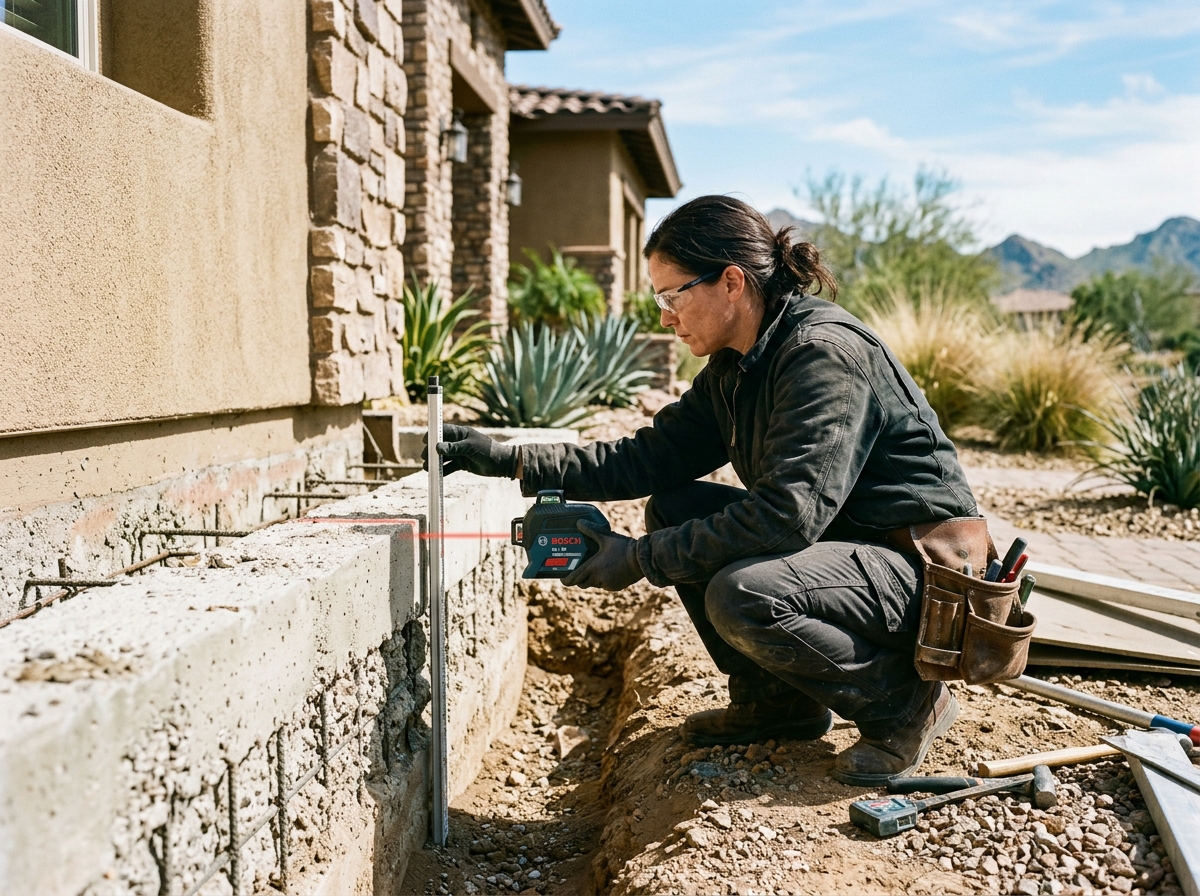
Permanent Non-Invasive Structural Wall Stabilization
High-modulus carbon fiber fabric is bonded directly to cracked or deflected masonry surfaces using structural two-part epoxy resins. Once cured, the carbon fiber becomes an integral structural component of the wall, permanently resisting inward hydrostatic pressures and preventing catastrophic wall shear.
Carbon Fiber Grid Wall Straps
Vertical high-tensile composite straps arresting inward rotational bowing along stem walls.
Concrete Crack Stitching Staples
Cross-stitch carbon fiber staples stabilizing tension fractures across concrete slabs and stem walls.
Top & Bottom Bracket Anchoring
Galvanized sill plate anchors and footer brackets locking the carbon strap across the entire structural span.
Structural Failures Resolved by Carbon Composites
Recognize these indications in your Scottsdale residence. Each represents a predictable response to sub-surface soil shifting.
Indicator: Inward Bowing Basement & Stem Walls
Permanent Remedy: Permanently halts inward wall displacement before masonry reaches structural shear failure.
Indicator: Horizontal Mortar Joint Fractures
Permanent Remedy: Transfers tensile loads across fractures, preventing exterior moisture from migrating through separated blocks.
Indicator: Corner Structural Separation
Permanent Remedy: Carbon fiber corner wraps mechanically interlock adjoining wall sections against differential shifting.
Composite System Material Specifications
Hardware components and chemical formulations selected specifically for long-term endurance in desert conditions.
Aerospace-Grade Carbon Weave
Continuous unidirectional fibers delivering over 500,000 PSI tensile strength.
Structural Epoxy Saturation Resin
High-viscosity adhesive chemically bonding carbon matrix directly into concrete pores.
Zero-Profile Flush Finish
Ultra-thin straps that can be primed and painted directly over, remaining virtually invisible.
Applications for Carbon Fiber Technology
Calibrated execution tailored to residential estates, communities, and commercial facilities.
Subterranean Garages & Hillside Walkouts
Homes cut into steep terrain facing continuous lateral earth pressures.
Masonry Stem Wall Foundations
Homes constructed with concrete block footings experiencing horizontal pressure.
Architectural Retaining Walls
Landscaping and perimeter structural walls showing early indications of tilt.
Engineering Suitability Criteria
Key geological and structural variables evaluated during our initial on-site CAD elevation survey.
Degree of Inward Deflection
Carbon fiber is optimal for walls bowed less than 2 inches. Deflections exceeding 2 inches may require helical tiebacks.
Surface Concrete Integrity
Concrete surfaces must be mechanically ground down to sound aggregate to ensure deep epoxy bonding.
Sill Plate Mechanical Attachment
Top brackets must securely bolt to the wood rim joist to prevent wall shear at the foundation transition.
Scottsdale Hillside Soil Dynamics
In foothill areas surrounding McDowell Mountain and Pinnacle Peak, retaining walls hold back decomposed granite and expansive colluvium. Flash-flood monsoon rains saturate this backfill rapidly, increasing lateral wall pressure by thousands of pounds per linear foot. Carbon fiber straps absorb these severe cyclic shock loads effortlessly.
How the Carbon Fiber Wall Reinforcement Process Works
A clear, disciplined 5-stage progression from initial phone dispatch to certified project sign-off.
Deflection & Laser Plumb Mapping
Technicians measure exact horizontal bowing deflection across every wall section.
Surface Preparation & Grinding
Diamond grinding wheels remove paints and sealers, exposing clean structural masonry.
Epoxy Primer Application
Structural epoxy is rolled onto concrete, penetrating capillary pores for maximum adhesion.
Carbon Fiber Strap Saturation & Placement
Woven straps are embedded under high tension and saturated with bonding resin.
Mechanical Top & Bottom Securing
Steel top rim anchors and footer brackets mechanically pin the composite assembly.
Homeowner Preparation for Wall Reinforcement
- ✓ Clear storage items, shelving, or equipment 3 feet away from foundation walls.
- ✓ Ensure electrical panel breakers for the work area are accessible if grinder hookups are needed.
- ✓ Vacuum dust barriers will be erected by technicians to protect adjacent living areas.
Cost Considerations for Carbon Fiber Repairs
Costs depend on the number of straps required (spaced according to engineering design, typically every 4 to 5 feet), total wall height, and whether top and bottom mechanical anchor brackets are specified.
Ready to Schedule Your Carbon Fiber Wall Reinforcement Diagnostic Survey?
Speak directly with dispatch. We review your foundation symptoms calmly and schedule a digital on-site CAD elevation mapping.
Recent Carbon Fiber Wall Reinforcement Projects Across Scottsdale
Completed field repairs documenting our commitment to non-invasive techniques, strict code compliance, and structural permanence across Maricopa County.
Residential Elevation Correction & Structural Stabilization
Following laser CAD deflection mapping that documented 1.4 inches of perimeter footer drop, our crew deployed Carbon Fiber Wall Reinforcement protocols. Full elevation recovery was achieved, closing drywall stress cracks and restoring permanent structural foundation balance.
Where We Provide Carbon Fiber Wall Reinforcement
Our specialized crews deliver prompt dispatch to homes and estates throughout these premier communities:
Frequently Asked Questions About Carbon Fiber Wall Reinforcement
Direct answers to common homeowner questions regarding duration, warranties, and engineering methods.
How strong is carbon fiber compared to traditional steel beams?
Carbon fiber possesses approximately ten times the tensile strength of steel, does not rust or corrode, and takes up zero usable interior room space.
Can I paint over carbon fiber straps once installed?
Yes. Once the structural epoxy cures, the low-profile straps can be easily primed and painted to match your garage or basement walls.
Will carbon fiber straighten a wall that has already bowed?
Carbon fiber is designed to permanently stabilize and stop further inward movement. If a wall needs to be pushed back plumb, hydraulic tiebacks or excavation may be required first.
How long does the epoxy bonding process take to cure?
Structural epoxy cures to full structural design strength within 24 to 48 hours depending on ambient temperature.
Is carbon fiber suitable for concrete block (CMU) walls?
Yes, carbon fiber is engineered specifically to stabilize both poured concrete and hollow or core-filled concrete block masonry walls.
Restore Permanent Quiet to Your Scottsdale Foundation
Speak directly with our local geotechnical dispatch team today. Schedule an unhurried, objective CAD elevation survey.
Monday–Sunday, Open 24 Hours • Fully Licensed & Insured Technicians